On the day hundreds of thousands marched in France against the state of its schools, Jean-Rémi Girard, president of the SNALC, told France 24 Debate that the explosion of anger in the lycées surprised only the government. For teachers who work with students every day, he explained, the crisis in national education has been obvious for years: not enough teachers, nobody wanting the job anymore, and classrooms that turn into “ovens” in every heat wave. He credited the protesters with having been heard despite the violence of the evening, but denounced a disproportionate police response that sent students with no record of violence into custody. He also took aim at a government with “nothing to give”: the Prime Minister’s five priorities for schools come with “zero euros”, and the teachers promised as replacements were cut in earlier years. As for the way out, he is under no illusions: these problems will not be solved “in a week, a month or a year”, and the hope now lies in next year’s budget choices.
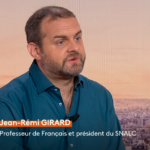
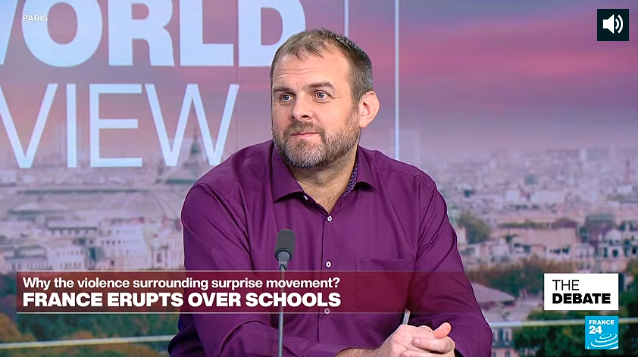
Jean-Rémi Girard, president of the SNALC (Syndicat national des lycées, collèges, écoles et du supérieur) and a French teacher in Asnières-sur-Seine, was a guest on the France 24 Debate (“France erupts over school”) on Tuesday 7 October 2026.
France24 – François Picard : Top of the fold, as we say in newspaper parlance, is the violence, at least for today, says Celeste. Do you agree with that, Jean-Rémi Girard?
SNALC – Jean-Rémi Girard : I think today could have been much more violent, and the protests went quite okay from a French point of view, I would say. That’s saying something. But no, it could have been much worse. We were afraid that someone would be really badly hurt or even would die. That’s what happened some time ago. Most of the protesters were here for the conditions in high schools, for the education system. And I think they were heard. They were able to say what they had to say without having just images of violence everywhere. Most of the protesters, they were people just asking for better schools, better conditions, and that’s what happened most of the time.
France24 – François Picard : Jean-Rémi Girard, your reaction to what that high school principal in Paris experienced?
SNALC – Jean-Rémi Girard : We’ve had a lot of those. I was in Grenoble last week, and we had some in a high school, with rioters just wanting to break windows.
France24 – François Picard : Who are these rioters?
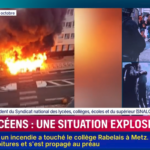
SNALC – Jean-Rémi Girard : That’s a very good question. Those are young people. Some of them, not all of them, are high schoolers, but not from the high school they’re aiming at. There are people who are extremely violent, who are quite desperate also because their living conditions are not good, and they want to fight against the police. And the students from the high school were just saying, “That’s not us, we’re not the ones breaking our own high school.” But yes, there was a lot of damage. More than 80 national education workers were hurt during the week and a half of the movement. A lot of students were hurt, some policemen too. So that was not an easy protest in the long term.
[…]
France24 – François Picard : You heard Celeste say, “Only one arrest at my high school.” What was your reaction?
SNALC – Jean-Rémi Girard : Oh, we had three last Tuesday. And they weren’t breaking anything. They weren’t burning anything. I think clearly the police overreacted in those specific conditions. Two of our students went into custody and they’re going on trial. One is a minor, one is an adult: two girl students who are not rioters at all. I had one of them last year in my class. She’s not a rioter. She was just afraid and didn’t know what to do, and wanted to help her friend, thinking she was being assaulted by the police. It’s very chaotic when there is tear gas. We cannot know how our students will react. Those who are not the rioters, those who are just students wanting better conditions, they don’t know how to deal with this situation.
[…]
France24 – François Picard : And have they been held up to 48 hours?
SNALC – Jean-Rémi Girard : My student was held for 29 hours.
[…]
France24 – François Picard : Okay. What about you, Jean-Rémi?
SNALC – Jean-Rémi Girard : Oh, we do have school, because the Prime Minister said nonsense. That’s not what’s happening. He probably just misread his paper.
[…]
SNALC – Jean-Rémi Girard : The national Ministry of Education is not saying that, and the headmasters cannot do that. Most high schools aren’t closed, most high schools aren’t blocked in France. Why would you spend three days talking with students who have been working, with no protest in the school? So that’s not what’s happening. The headmasters can say, “Tomorrow morning or Thursday morning or Friday morning…” There have been online classes, I’ve seen that, but that’s when the high schools were blocked. For tomorrow or Friday morning, the teachers can have one or two hours to talk to one another, and then the students can have one or two hours to talk. But that will be all. It won’t be three whole days anywhere in France.
[…]
SNALC – Jean-Rémi Girard : Amélie Oudéa-Castéra stayed for 28 days.
(In response to Richard Werly’s remark on the five education ministers since 2017.)
France24 – François Picard : So, Jean-Rémi Girard, that brings us to this moment in time. Surprise movement, right? No one was expecting this. We said at the outset that the grievances were there, but for it to erupt all of a sudden, when you have a minority government, empty state coffers and elections coming up, no one expected that. So why is it happening now, and where does it go?
JEAN-RÉMI GIRARD [30:29]: No one was expecting it, except for the teachers and the students, probably, because we are in the classrooms. We are with the students. We know how national education is in a very big crisis in France. We cannot find enough teachers. Each year we have a lack of teachers. Nobody wants to do that job anymore. That’s a very big problem. So it’s not surprising. What is surprising is that we didn’t know when it would happen, but it was bound to happen one day or the other.
And yes, it’s happening in the most difficult political context, because the government has nothing to give. Sébastien Lecornu wrote two-page letters about five priorities. There is zero euros, zero euros on those five priorities. They say, “We will be replacing teachers at more speed.” They don’t have those teachers, because they suppressed them in the years before. In the first five years of Emmanuel Macron, there were more students in middle school and high school, and they suppressed 8,000 teachers. So basically we don’t have those teachers to come when a teacher is sick, when a teacher is pregnant. We don’t have anyone.
France24 – François Picard : Jean-Rémi Girard, this is the beauty of France, right? You have the state, and everybody thinks that everything is decided at the top, and then there are the regions, and then…
SNALC – Jean-Rémi Girard : Yes, that’s what we call, in union language, table tennis between the state and the region. “That’s your problem.” “Oh no, that’s your problem.” “We need money to solve the problem, so give us money.” And the heat waves last spring were awful. We don’t have classrooms, we have ovens. Those are all buildings from the 60s and 70s. When there is a renovation, it’s usually painting, changing tables and chairs, putting in a big interactive screen, things like that. But the walls, the ceilings, the windows stay the same, and that’s not up to par. With climate change, our high schools, middle schools and primary schools are not okay.
France24 – François Picard : Is it going to be what the French call a “dialogue of the deaf” going forward, when we talk about reforming? Or is it just going to be, well, lock them up and that’s the end of it?
SNALC – Jean-Rémi Girard : I’m a union leader, and we’ve raised those issues for many years, and yes, it’s a dialogue of the deaf.
France24 – François Picard : Is this a turning point right now? Will there be dialogue as a result?
SNALC – Jean-Rémi Girard : What we hope is that next year’s budgets will make some different choices, and that perhaps they will say, “Perhaps we will try to find money elsewhere than in national education.” We know that will be quite difficult, and we know they have no majority to pass the budget, so that’s a problem. But those problems won’t be solved in a week, a month or a year, because they can’t be.